
Change by Design’s creative practice unfolds self-awareness in layers. Together, we navigate three interwoven stages, learning to sense, listen, and witness The Self with curiosity, compassion, and truth.
This practice is not new; humans have always made sense of themselves through creative expression. Every culture, every era. This practice is simply that – made intentional.
Clients are the source material, and together we learn to read it.
We begin with creative practices: drawing, painting, journaling, mark-making—that open access to the subconscious. This is where suppressed truths and untapped insights live.
Through intentional conversation, not to psychoanalyze or fix, but to reflect and connect, we begin to notice how early beliefs, habits, and societal conditioning have quietly shaped our reality.
This work is more than a series of aha moments that are difficult to integrate on their own. Together, we co-create simple, intuitive ways to carry self-awareness into daily life. Because change only lasts if it’s lived.
Every session is a co-creation.
You bring YOUR truth. I hold the mirror.
What we discover becomes the map for changing your life – by design.
Here’s what we know about access:
People don’t lack inner knowing. They lack practiced access to the subconscious and thoughtful discernment about what is revealed. Most of us have glimpsed it in a sudden idea, an unexpected solution, a knowing that arrived before we could explain it. The difference is learning to recognize it, trust it, and work with it intentionally. Access isn’t a personality trait, a level of intelligence, or introspective depth. It’s neurobiological, environmental, and experiential.
Here’s what created the inaccessibility:
Many of us were never mirrored. Never asked who we are—never given the space to feel without performing, complying, or managing.
Here’s what runs in the background:
We are also meaning-making machines. We take what happens, assign it a story, and then live inside that story as if it were fact. The problem isn’t that we make meaning; it’s that we rarely stop to ask whether the meaning we’ve made is even true.
Here’s what the practice makes possible:
The creative practice creates the space to do exactly that: to understand where our narratives came from, to sense what’s true right now, and to make choices about where we’re going — on our own terms.
Here’s what that honestly looks like:
This isn’t about producing beautiful pages, though that often happens. It’s about what surfaces as the pen moves. And what surfaces is entirely your own: sometimes simple, sometimes profound, sometimes uncomfortable, and more.
Here’s how it builds over time:
Think of it as building a muscle: the muscle of tuning into who we are and what is genuinely true for us. The more we practice, the stronger it gets. Until attunement becomes integrated as a new way of operating with greater consciousness, purpose, and intention.
The practice doesn’t just open the door; it gives us the tools to work honestly with whatever walks through it.
This is not remedial work. It’s generative.
Research Sources: Malach (2024), Frontiers in Human Neuroscience; Liu, Li & Zhao (2026), Behavioral Brain Research; Chan, Lambon Ralph & Robinson (2026), Cortex.
Imagination → We’re all born with it.
Ingenuity → Use it to break norms.
Resourcefulness → Fuels our growth.
Creativity → It’s part of our core.
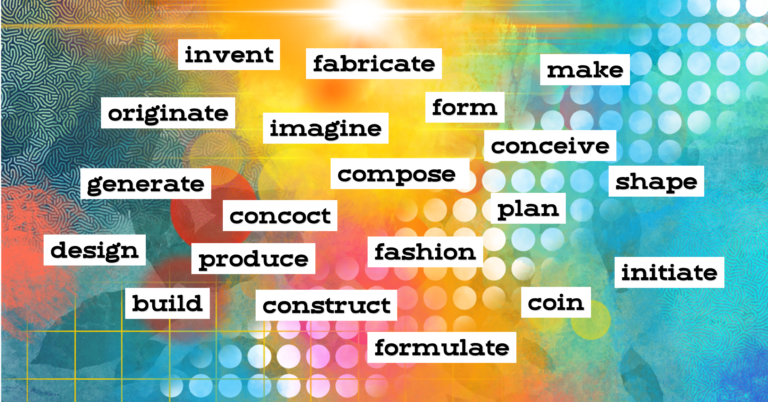
Made. Built. Invented. Fabricated. Produced. Designed.
We use words like these every single day to describe dinner, a project plan, a solution pulled together on the fly. Then turn around and say “I’m just not creative.”
Here’s what we know to be true: anyone who has ever asked why, imagined a different way, or figured something out is creative. Creativity is not solely about being artistic. It’s about being alive to possibility.
This practice is not new. Humans have always used creativity to understand themselves. Every one of us has had the experience of “yes, that’s good” after solving a problem, making a meal, mastering a craft, pitching an idea, etc. There may be a rare exception, yet it’s nearly impossible to find. Everyone is part of a lineage based in creativity that stretches back to the beginning of human life.
With creativity and possibility at our side, we are equipped to open the door to observing the multifaceted people we are.
Intentional Creativity is creating with mindfulness.
Creatively Cultivating Consciousness (CCC) is a creative self-awareness practice rooted in more than 40 years of Kami’s personal experience with artistic exploration and informed by formal training and certification in the Intentional Creativity® approach.
Creatively Cultivating Consciousness uses a creative process as a pathway to greater self-awareness. We begin with a question, an intention, or an area of life we want to understand better. Through image-making, drawing, doodling, painting, and reflective inquiry, we create a space for observation, discovery, and insight.
In life, we experience things that are difficult to understand because they feel overwhelming, uncertain, or incomplete. At other times, thoughts, behaviors, or perceptions operate outside our awareness and influence how we move through the world. No matter the circumstances, creative expression invites us to pause, pay attention, and engage with life experiences in different ways.
The creative process creates opportunities to notice how we interpret, process, perceive, and make meaning of our life experiences.
Through image-making and reflective inquiry, we can engage with experiences from a place of reflection rather than reaction and become aware of thoughts, beliefs, emotions, and perspectives that were present all along but remained outside conscious awareness.
As awareness expands, what once felt vague or charged with confusion can become clearer. We may recognize patterns, inherited narratives, assumptions, or possibilities that were previously hidden from view. New perspectives emerge, and with them, greater capacity for choice.
The examples below demonstrate metacognitive drawing and doodling practices guided by reflective inquiry. These inquiries focus attention on specific aspects of life, helping bring into awareness what may have previously gone unnoticed.
This work aligns with principles of self-awareness theory, which suggests that we can observe and reflect on our thoughts rather than simply being carried by them (Duval & Wicklund, 1972). Increased self-awareness has been associated with a variety of personal benefits. Some common examples are listed beneath each image, though each individual’s experience of creative self-inquiry will be unique.


met·a·cog·ni·tion | PSYCHOLOGY | noun: metacognition | awareness, and understanding of one’s own thought processes.
Many ways to practice creative self-awareness exist. One of the simplest is metacognitive drawing, or doodling while reflecting on an inquiry question. Creative self-awareness can also be practiced through other forms of creative expression, including working with clay, dancing, knitting, kneading bread, gardening, or listening to music.
The specific activity matters less than the quality of attention we bring to it. The goal is to create conditions that support noticing our thoughts, feelings, behaviors, beliefs, and assumptions as they arise.
When using a modality other than drawing or painting, it can be helpful to keep a journal, pen, or pencil nearby to capture insights, observations, or questions that emerge during or shortly after the experience. Writing creates an opportunity to reflect on what was noticed and preserve it for later exploration.
Coming soon: Three introductory videos demonstrating an entry-level approach to Creatively Cultivating Consciousness.
Watch the basics of the Creatively Cultivating Consciousness Approach.